


This is a lightly copyedited version of an essay originally published by Eurasianet.org as part of a series initiated and coordinated by Dr. Nagis Kassenova, director of our Program on Central Asia, in which retired U.S. diplomats share their experiences of working in the region during its early years of post-Soviet independence.
Diplomacy has many faces: sometimes adversarial, sometimes in a partnership, mostly, like many human interactions, deeply complex. It is layered by interactions with host country officials, journalists, and business executives and the guidance and interest from Washington. Managing all these relationships requires teamwork, good timing, and a certain amount of luck.
When the 9/11 terror attacks occurred, our [U.S.] security focus shifted to Afghanistan and the surrounding nations. Kyrgyzstan’s southern border is 125 miles from Afghanistan. We needed air bases for operations. You don’t flip a switch and get an agreement. It takes lots of patient and consistent work.
Kyrgyz Independence Day falls on August 31. I arrived in 2000, the day before the 9th anniversary of independence, with no time to present my ambassadorial credentials and officially join the festivities. Sheila Gwaltney, the brilliant chargé d’affaires (and later ambassador to Kyrgyzstan), represented the United States.
Two weeks later, I formally presented letters of credence from President Clinton to President Askar Akayev. The ceremony took place at the Bishkek White House, the seat of Kyrgyzstan’s executive branch. The Kyrgyz side sent a “Chaika,” a Russian-made limousine that looked like a very boxy old Lincoln Continental. They literally rolled out the red carpet for us, and we tried not to trip as we walked up the stairs. I gave my speech, the first few sentences in Kyrgyz and the rest in Russian. Then the president gave a speech, also in Russian. Then we had a little tête-à-tête for about 40 minutes.
The ambassador of India presented his credentials shortly after my ceremony and was accorded an equally dignified event. Later, when I got to know President Akayev better and had a relatively comfortable relationship, we discussed his overall foreign policy approach. He said that as a small country surrounded by powerful neighbors, Kyrgyzstan strived to be friends with all.
The German ambassador, who had been there for two years, was particularly helpful in guiding me through the thicket of Kyrgyz politics. He said, “John, this is the best place to be an ambassador. I can easily meet with government ministers and see the president with a few days’ notice. Berlin is far away, and not very knowledgeable about the country. If I need instructions, I send them to Berlin, which then sends them back to me.”
My deputy, Sheila Gwaltney, made sure I was fully briefed on the current situation, steered me in the right direction, and warned me off the bad actors, particularly those viewed as tainted by the public; for example, the head of the Customs Service, whose magnificent residence on Lake Issyk-Kul perhaps stood as a testament to his shrewd ways, given his modest salary.
Of course, with Russia, China, and the United States as the largest geopolitical players, we were usually treated with special care. The one difference is that, through various regional cooperation agreements, President Akayev and other Central Asian leaders regularly met with Russian leader Vladimir Putin. The United States, of course, had a different relationship with Akayev: The U.S. ambassador was the key link with Washington. That made my work in some ways easier, but often more tense.
Elections as Prelude to Manas Base Agreement
The autumn 2000 elections did not meet the standard of free and fair. Akayev’s main rival, Felix Kulov, was jailed early in 2000 on charges of corruption while he was mayor of Bishkek. Others were eliminated through their failure to meet proficiency standards for the Kyrgyz language (the president must be competent in the state language), even though one candidate was known for his Kyrgyz scholarship. On the morning of the elections, before the polls opened, I dropped by a polling station and asked to see the ballot boxes. One was already stuffed with filled-out votes. There were other flaws that day.
The country team gathered to see what responses we could make. Since U.S. Agency for International Development (USAID) funding for projects was one area the Kyrgyz leadership would notice, we paused funding on several non-humanitarian initiatives.
But a feud with the head of state is never useful in the long term, and we at the embassy cast about for something that would not be linked to the election, while being useful for the country. We thought an investment conference focusing on the comparative economic advantage of “Kyrgyzstan, Inc.” would fit the bill. I talked it over with my German colleague, and we pitched it to the president together in early 2001.
Akayev more than welcomed the idea. It appealed to both his intellectual side (he was trained as a physicist and mathematician) and his fondness for large, dramatic events. The presidential machinery kicked into high gear. He chose the government compound at Lake Issyk-Kul as the venue.
Sitting at 5,200 feet above sea level with warm days and cool nights, surrounded by snow-capped peaks and looking over the 2,400 square-mile lake, it had two very large, stately houses and many other cabins that could accommodate the gathering we had in mind.
Along with Kyrgyz officials and the German Embassy, we worked up an impressive array of participants. Djoomart Otorbaev, an experienced political player who later served as the country’s prime minister, was particularly helpful in developing the conference theme. He suggested that the Netherlands serve as a model, a country that leveraged its location and talent to find areas of comparative advantage to develop its economy.
In July, we welcomed the former head of Volkswagen, who had opened the Chinese market to the company’s cars, as well as heads of mining companies, Phillips, the World Bank, the IMF, the European Bank for Reconstruction and Development (EBRD), and other private-sector investors. The results of the two-day conference brought changes to Kyrgyzstan’s commercial code, as well as led to the development of mechanisms for government agencies to be accountable and assist, not hinder, business in the country. It became a model that the EBRD used in other countries.
As with many initiatives that start with the best intentions, it did not live up to the high expectations we had. But it did bring about some benefits. Quarterly meetings with President Akayev allowed for the quick resolution of disputes. There was also a flurry of legislation that aimed to trim a thicket of permits and regulations.
But several key challenges — corruption, and the small size of Kyrgyzstan’s market — continued to hinder efforts to attract large-scale investment.
The benefit to our relationship with Kyrgyzstan came only two months later, on 9/11, when the twin towers came crashing down. I was with my son and the embassy doctor in Naryn province, near the Chinese border, about five hours from the capital, Bishkek, when the tragedy occurred. It was about 8pm (9am in Washington) when a call came from the Deputy Chief of Mission (DCM) Deborah Klepp. She said, “You better come back right away.” I said, “Deborah, I’m sure you can handle whatever issue has arisen.” She said, “Turn on the TV.” We went down to the lounge of the Celestial Mountain Inn, where we were staying. As we watched, we saw the second airplane hit the second tower.
We didn’t know whether our people or the embassy would be attacked next, who was behind it, or whether the various Islamic terrorist groups in the country had mobilized. Deborah said that we should stay where we were, that a group of U.S. Special Forces training with the Kyrgyz military would come from Bishkek to bring us back.
At around 3am, the group arrived in two black SUVs, well-armed and looking grim. We were whisked back straight to the embassy, arriving at 9am. Even though the attack occurred late the previous evening, Bishkek time, and the embassy was a good, long walk from the last stop of public transportation, the entrance gate was piled high with flowers and notes of condolence.
As soon as I got in, I had a call from President Akayev. He expressed his sorrow at what had happened, asked that I send his deep condolences to President Bush, and that he stood ready to help in any way he could. President Akayev arranged for letters to be delivered to the embassy for President Bush and the American people, expressing his sadness and solidarity.
As operations started to unfold in Afghanistan, the coalition (then not NATO) needed a base for combat aircraft and logistical support. A delegation led by a Turkish general reviewed options in Tajikistan, Kazakhstan, and Kyrgyzstan. In early December, I got a call from Tommy Franks, CentCom commander, whom I had met a few times.
“John, I want Manas airport as the base. Please arrange it.”
“General, I receive my instructions from Secretary Powell, so please ask him to send the message.”
It came quickly. I called the head of the Kyrgyz National Security Council, Misir Ashikulov, and said we would like to use Manas as a base for Afghan air operations. I also asked whether I could meet with President Akayev to discuss the request. Deborah Klepp, the DCM, our interpreter, a CentCom liaison officer, and I were soon thereafter ushered into President Akayev’s office. Also present were his interpreter, the ministers of defense and foreign affairs, the national security chief, and other staff.
I outlined our desire to use the civilian Manas Airport for Afghan combat and supply aircraft, noting there would be minimal disruption to commercial operations. The president asked for assurances that Manas would be used for missions relating to Afghanistan only, and not, for example, Iraq, and that it was a temporary measure. I confirmed both.
He directed the defense and foreign ministers to work with me to hammer out an agreement. Before leaving, I asked: “Mr. President, you don’t have to answer, but did you discuss this with President Putin?”
He said, “I did.”
And then nothing. Curiosity getting the better of me, I asked: “What did he say?”
“You have to do what’s best for your country.”
The negotiations went quickly, though they were quite intense at times. The roadblocks to getting to yes were objections from the legal experts at the Kyrgyz Foreign Ministry and from lawyers at the Pentagon, who insisted on measures that I knew the Kyrgyz would find not just objectionable but insulting.
One key sticking point from DOD centered on landing fees. DOD policy was that the coalition would not pay landing/takeoff fees, which made sense if we operated from a military base or a government-owned airfield. But Manas was a civilian airport, owned not by the Kyrgyz government but by a joint-stock company. I argued that it fell outside the DOD standard policy.
A big thanks goes to Debra Kagan at the State Department, who forced the Pentagon to back off. I asked how she did it. She said she threatened to cut off a certain part of their anatomy if they didn’t come around. As a side note, with landing fees at $7,000 a pop, it helped stave off a parliamentary move a year later to abrogate the base agreement.
Two factors helped us finalize the Manas agreement. On the military-to-military level, generals Anthony Zinni, and then Tommy Franks visited Kyrgyzstan several times and invited the Kyrgyz defense minister to visit CentCom headquarters in Florida. That gesture was enhanced by a commitment to hold annual bilateral defense consultations. In addition, the Kyrgyz Republic was one of the few countries that were notified just before combat operations began in Afghanistan. Beginning in October, CentCom provided the embassy with daily sensitive intelligence briefings to share with the Kyrgyz on the conduct of the war in Afghanistan. As a result we had built up a solid level of trust and goodwill when, two months later, we entered negotiations.
At the presidential level, we had a relatively smooth negotiation as a result of our cooperation and support of the investment conference two months earlier. President Akayev wanted a path to growth and investment, wanted a spotlight on Kyrgyzstan, and felt that the level of participants reflected well on the country and his presidency. USAID’s stepped-up technical and material support made a huge difference. It established our bona fides to push forward an initiative helpful to Kyrgyzstan, and he could highlight it as a success. Without that prelude, our negotiations would have been more difficult, and our setting up and operating the base would have been more fraught.
Implementation Is Never Easy
Once negotiations concluded, the Kyrgyz side explained that they considered the draft agreement a treaty. For the U.S. side, it was an agreement and, as ambassador, I could sign on behalf of the United States. Kyrgyz law, meanwhile, required it to be ratified by both chambers of the legislature and signed by the president. It required some lobbying with parliament members and some testifying before their oversight committees. Reaching out to the Kyrgyz public constituted a critical element in ensuring the coalition (not NATO) base didn’t cause undue irritation to the Kyrgyz government or harm the image of the United States. By the third week of December, the treaty was ratified by the Jogorku Kenesh (parliament) and was signed by President Akayev.
Though the treaty laid out the ground rules, operating out of a civilian airport in the capital required operational agreements, setting up joint air and ground traffic control, securing the munitions the combat aircraft needed, deciding on the degree of transparency, and many other considerations neither the Kyrgyz nor our side had thought of until that point. While securing the initial agreement to deploy U.S. forces to Kyrgyzstan had its challenges, things could never be simple. Our plan was to include our coalition partners under an umbrella agreement. No such luck.
The Kyrgyz insisted that each participating country work out its own status of forces agreement (SOFA), and Pentagon lawyers had their own reservations about our including others. With the exception of Turkey, the other partners had no embassy in Bishkek. Many were accredited from Almaty [in Kazakhstan], a four-hour drive away. The French and Canadians negotiated their own SOFA. Both used our agreement as a framework, since the wording had already been translated into Kyrgyz and Russian. The French ambassador mentioned that this was the first time in his diplomatic career that he had ever sent a document, mon Dieu, in English to the Quai. His work was particularly critical since CentCom air assets weren’t available. Our coalition partners, particularly the French, carried the initial load (in addition to supplying the base’s deputy commander) in providing air combat support to troops on the ground in Afghanistan.
Our superb staff, supplemented by the CentCom liaison, Navy Capt. John Volkoff, carried the load of securing SOFAs for the remaining coalition partners. We coordinated and tracked the SOFAs as well as overflight and landing clearances with the Kyrgyz government for the governments of the Netherlands, Denmark, Italy, Spain, Australia, Norway, the Republic of Korea, and New Zealand. Keep in mind, we were minimally staffed, and this work represented an extraordinary burden. I was never prouder of us in the Foreign Service and the embassy team for accomplishing one of the more complex diplomatic efforts at the time.
In addition to the extraordinary support from top-level Kyrgyz government officials, I would also be remiss not to mention two mid-level Kyrgyz officials. As DCM Deborah Klepp noted in a paper presented at the National War College, “MFA desk officer Samargul Borbieva, with single-minded dedication, skillfully shepherded the US and Coalition SOFAs through the labyrinthine Kyrgyz bureaucracy and later helped resolve dozens of base problems that arose. Ministry of Defense Major Kosmos Ibrayev steered the day-to-day liaison with the base.”
Brig. Gen. Christopher Kelly served as the base’s first commander, arriving the day after President Akayev signed the treaty. DCM Klepp, in her analysis, noted “the base commanders credited the Embassy for the base’s existence and unanimously lauded the embassy’s coordination process. From day one, Brigadier General Chris Kelly and his key staff attended embassy interagency country team meetings to identify potential synergies and resolve issues before they became problems.”
Once the base began operations, our embassy team, working with Kyrgyz defense officials, sought ways to enhance the base’s and Operation Enduring Freedom’s image.
There were three vectors: the immediate neighbors affected by the noise of combat aircraft operating throughout the day and, less often, at night; the Kyrgyz government, including the legislative branch; and broader public opinion, particularly in the south, where the population was more religiously observant and distrustful of our intentions.
In addition to meeting with the neighbors and briefing them on what we were doing and why, we used DOD funds to repair schools, provide computers, and undertake infrastructure repairs. We opened the base to visits by government officials, MPs [i.e., lawmakers], and the diplomatic corps. As you might guess, the Chinese ambassador was particularly interested; the Russian ambassador showed up drunk and behaved badly.
In addition to mass media outreach to raise awareness with residents in the southern provinces of Osh and Jalalabad, we engaged Islamic clerics. Prior to 9/11, the embassy had arranged exchange programs to the United States for influential imams, introducing them to the Muslim-American communities. Just as we hoped to explain that we were not the great hegemon, we tried to dissuade those in the south that we were not the great Satan. Many imams who participated in the exchange ended up explaining that the United States was not an evil place.
On the security side, our regional security officer and others at the embassy had a deep working relationship with the Ministry of Interior and other security agencies within the Kyrgyz government. As a result, he shared useful intelligence with his base counterparts, reducing the risk to the base and its personnel.
Because of frequent turnover among commanders and base personnel, we needed to brief the incoming groups every 90 days. We had established a high degree of confidence with the CentCom command in our ability to manage these transitions, so we were able to quickly build an effective working relationship. We lobbied to retain base commanders for 180 days, which eventually became the standard tour of duty.
Ultimately, the embassy and the base operated not so much as two entities but as one, each understanding its respective role, making the partnership with the crucial parts of the Kyrgyz government smooth.
Opinions and recollections in this piece are solely those of the author, unless noted otherwise.
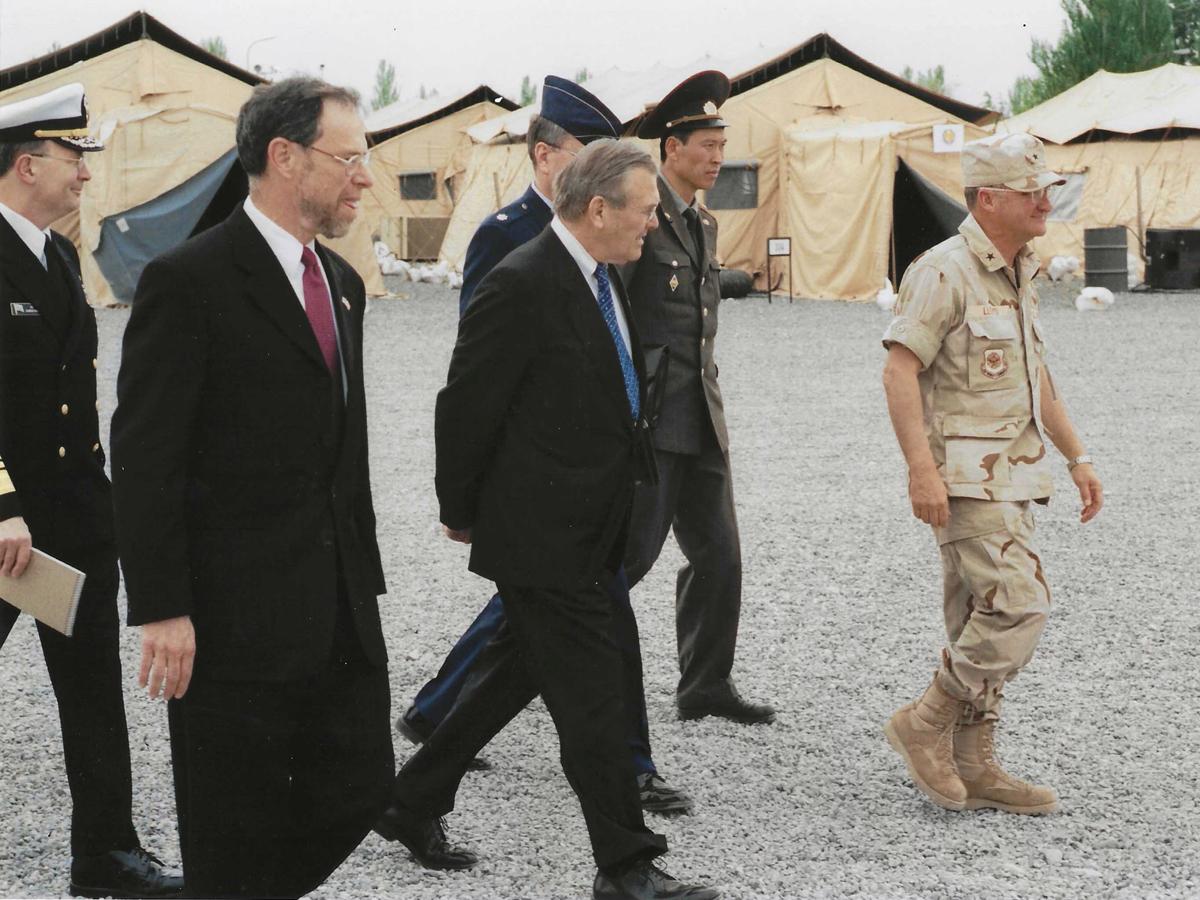
Ambassador John O’Keefe (second from the left), U.S. Secretary of Defense Donald Rumsfeld (center), and Manas Air Base Commander Gen. Wayne “Speedy” Lloyd (right).

Former U.S. Ambassador to Kyrgyzstan; Retiree Vice President, American Foreign Service Association
